
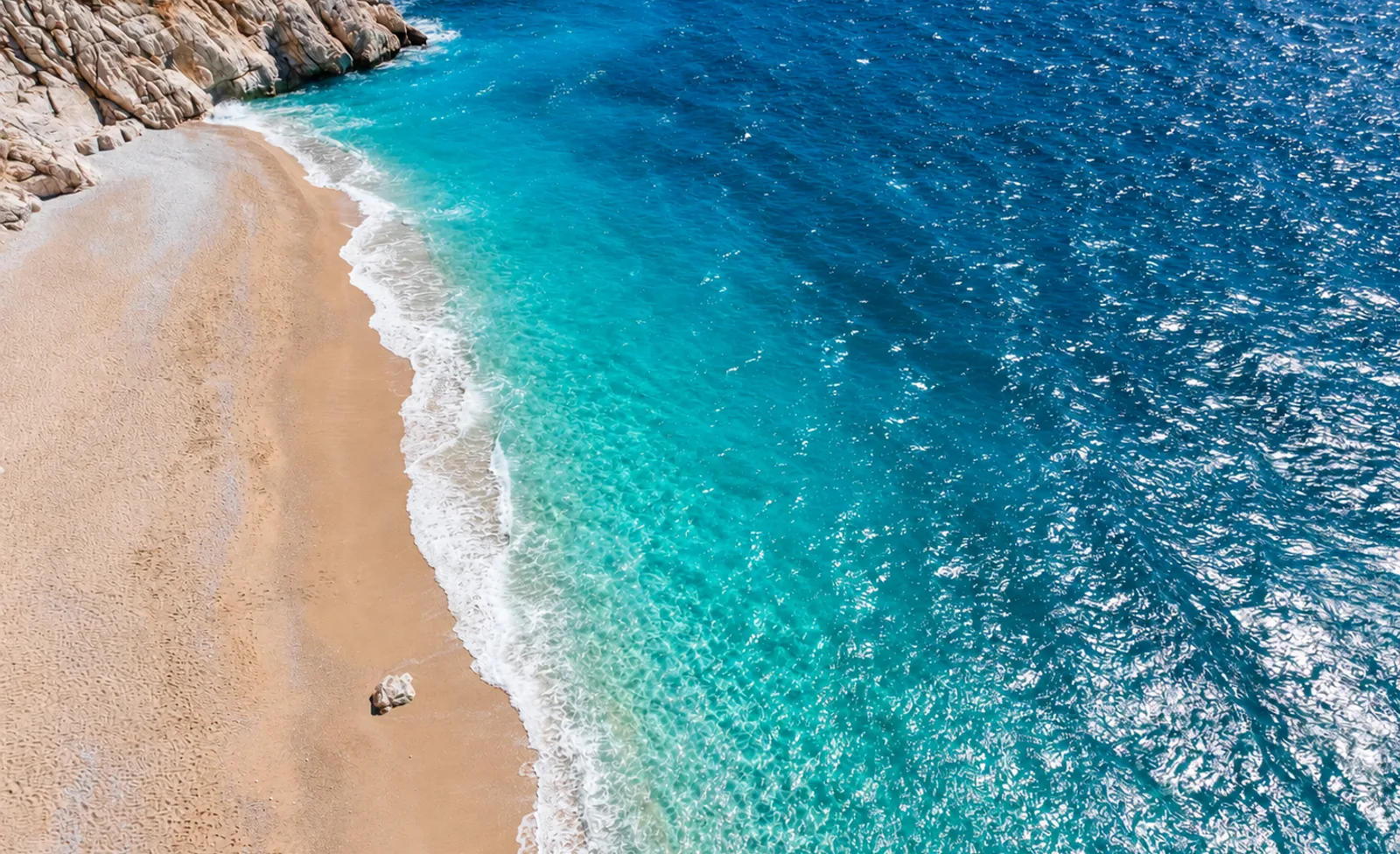
Kaputaş Beach, from our regional photography collection. Scene-setting image, rather than a photograph of every destination discussed in this guide.
Kaş Beyond the Harbour
The harbour is the obvious introduction to Kaş. The more interesting story begins when you realise how much lies beyond it.
Turquoise Society · 8 min read
Published
Kaş introduces itself easily.
A harbour. Boats. Streets climbing gently away from the water. Tables outside. Mountains behind. The outline of Kastellorizo — Meis in Turkish — across the sea.
It would be easy to stop there.
But Kaş becomes much more interesting when you realise that the harbour is not the destination’s boundary.
It is the point from which several different landscapes begin.
The ancient town is still here
Modern Kaş occupies ancient Antiphellos.
That statement sounds archaeological until you walk around town and discover how literal it is.
Antiphellos began as the harbour associated with inland Phellos and grew in importance as maritime trade developed. Its surviving remains run through the modern settlement and along the Çukurbağ Peninsula.
The most striking is the Hellenistic theatre west of the centre. Set against the hillside with 26 rows of seating, it faces directly towards the Mediterranean.
Elsewhere the ancient city appears more casually.
Lycian rock tombs occupy the slopes. Sarcophagi remain close to the harbour. On Uzun Çarşı, the monumental fourth-century BCE sarcophagus commonly called the King’s Tomb stands not in an isolated archaeological park, but in the contemporary town. Its Lycian inscription remains undeciphered.
That coexistence matters.
Kaş does not require you to leave the modern town in order to find the ancient one.
Look inland as well as out to sea
Antiphellos makes more sense when paired with Phellos.
Phellos sits inland above Kaş on Felen Dağı. In the fourth century BCE it was an important Lycian settlement; later, Antiphellos — originally its port — overtook it in prominence as maritime trade grew. Surviving remains include sections of fortification and Lycian tomb architecture.
The relationship between the two is a useful reminder that Kaş was never simply a seaside settlement disconnected from its hinterland.
The coast and the mountains were part of the same system.
Today that geography remains relevant for visitors choosing where to stay. A villa labelled “Kaş” can mean central town, peninsula, hillside or somewhere further inland.
The destination name is only the beginning of the question.
The peninsula changes the relationship with town
The Çukurbağ Peninsula extends west from Kaş and forms one of the town’s most distinctive residential and villa landscapes.
Here the relationship with the centre changes.
You are still tied closely to Kaş, but no longer necessarily living inside its streets.
That can be exactly what some travellers want: the town available when required, with the villa and the sea taking more of the foreground.
But this is where property-level information becomes crucial.
A map pin alone does not tell you whether walking is practical, how the road approaches the villa, where the nearest usable swimming access lies or whether a car materially improves the stay.
Turquoise Society will treat those as facts to verify rather than assumptions to attach to every peninsula property.
Kaş underwater
Some destinations use the sea as scenery.
Kaş uses it as territory.
Official tourism material identifies the Kaş–Kekova area as one of Türkiye’s significant diving regions, describing clear water and a variety of reefs, walls, underwater canyons and wreck sites.
This gives Kaş another identity beyond beachgoing.
For experienced divers, the attraction is obvious. But even for travellers who never put on a tank, the diving culture changes the way the town relates to the sea: boats leave with purpose, underwater geography is discussed alongside visible coastline, and the Mediterranean becomes something to explore vertically as well as horizontally.
East from the harbour
Leave Kaş by boat and the map changes quickly.
Limanağzı is one of the first bays east of town. Continue further and routes can reach Aperlai, Üçağız, Kaleköy and the wider Kekova area. Turkish tourism sources describe this coast as a sequence of bays, islands and archaeological landscapes connected naturally by water.
Üçağız itself occupies the site of ancient Teimiussa and functions as a natural harbour and departure point for boats towards Simena and Kekova.
Simena — modern Kaleköy — sits within the wider protected Kekova landscape. The area contains partially submerged ancient structures associated with seismic change along the coast, while settlement and archaeology remain closely interwoven.
Again, the most interesting thing is not one famous “sight”.
It is the relationship between sea, settlement and antiquity.
Walk out of Kaş
The Lycian Way passes through the broader Kaş landscape as part of its long route between the Fethiye side of the peninsula and Antalya. Official sources describe the route as following a mixture of old paths, historic tracks and routes through mountain and coastal terrain while linking ancient settlements.
For visitors this does not need to mean undertaking a multi-week expedition.
A shorter section is enough to see Kaş from another perspective.
From the road, the mountains are backdrop.
On foot, they become structure.
The relationship between ancient settlements, water, elevation and coastline begins to make much more sense.
What Kaş does particularly well
It would be easy to describe Kaş as charming, authentic or relaxed.
Those words are used about almost every Mediterranean town.
The stronger case for Kaş is more specific.
Those things are observable. They don’t require marketing language.
- An ancient Lycian harbour remains embedded within the modern town.
- The Mediterranean functions as an active diving and boat landscape.
- The coast opens east into the archaeological geography of Kekova.
- The mountains immediately behind connect Kaş with the older inland routes of Lycia.
Choosing a Kaş villa
The final question is not really whether you like Kaş.
It is which relationship with Kaş you want.
Two properties carrying exactly the same destination label can produce very different holidays.
- Do you want to walk into town frequently?
- Would you rather be on the peninsula and return to the centre when you choose?
- Is immediate sea access more important than being close to restaurants?
- Will you dive or take boats regularly?
- Do you expect to hire a car?
- How much of the holiday will happen at the villa itself?
Beyond the harbour
Our aim is therefore not simply to tell you that a villa is “in Kaş”.
It is to explain what being there actually means.
Because the best way to understand Kaş is to look beyond its harbour.
And then to keep going.