
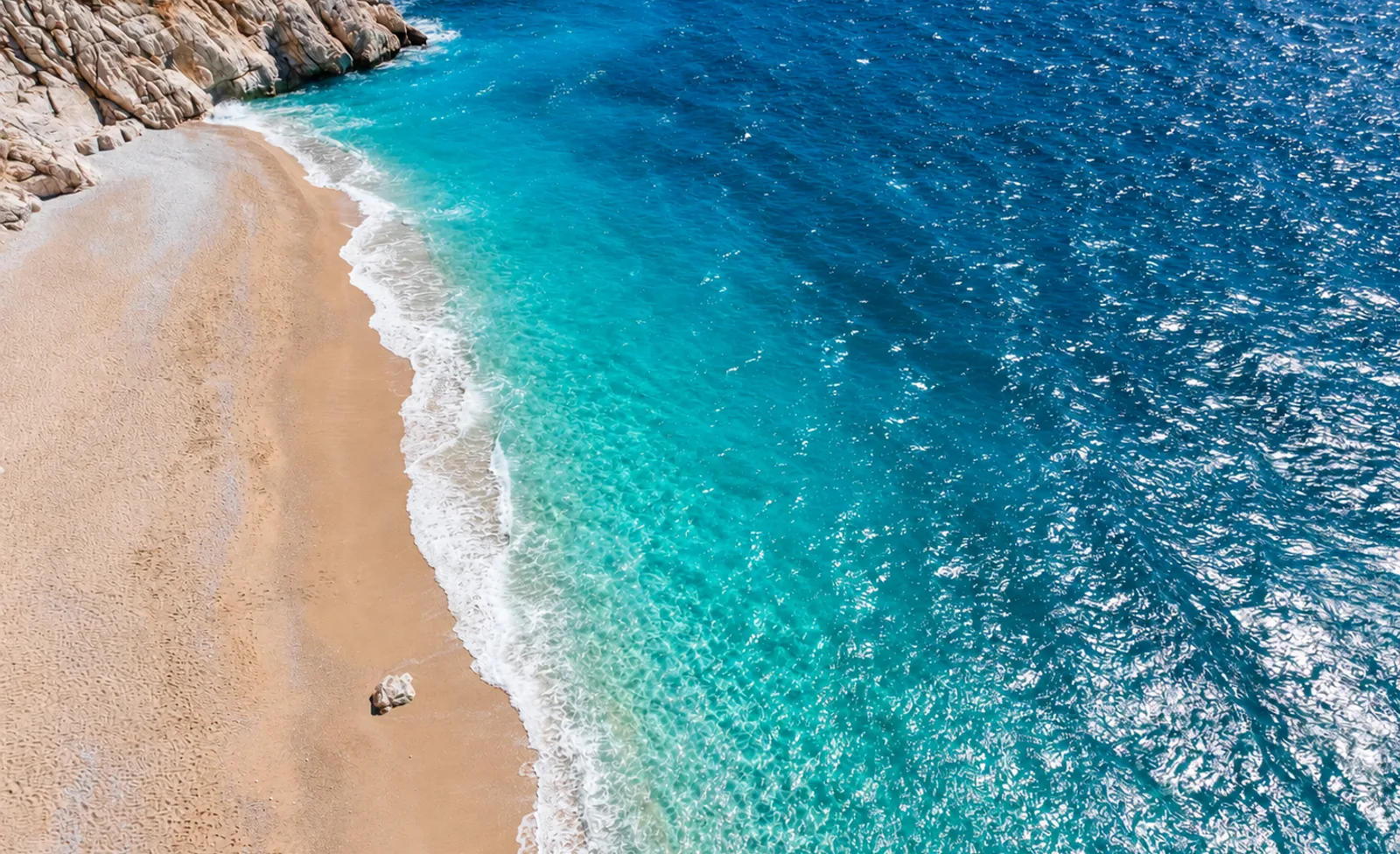
Kaputaş Beach, from our regional photography collection. Scene-setting image, rather than a photograph of every destination discussed in this guide.
Discovering the Turquoise Coast
The coast is often spoken about as a single destination. Look more closely and it becomes a sequence of very different landscapes, towns and ways of staying.
Turquoise Society · 8 min read
Published
There is a temptation to talk about the Turquoise Coast as though it were one place.
It isn’t.
Follow the shoreline through this part of south-western Türkiye and the landscape continually changes its mind. Mountains press towards the Mediterranean, small harbours appear between rocky headlands, villages climb inland, ancient cities surface beside modern roads, and long stretches of coast remain defined as much by archaeology and landscape as by tourism.
For Turquoise Society, that variety is the point.
The useful question is not simply where should I stay on the Turquoise Coast?
What kind of coast do I want to wake up to?
A coastline shaped long before tourism
The region was once Lycia, an ancient civilisation occupying much of the Teke Peninsula between modern Fethiye and Antalya.
Its traces are unusually difficult to separate from the contemporary landscape. Around Kaş, the remains of Antiphellos sit within the present-day town. At Patara, the ancient city spreads across the former harbour landscape behind the beach. Xanthos and Letoon, nearby, together form a UNESCO World Heritage property recognised for the exceptional evidence they preserve of Lycian civilisation, architecture and language.
Even the long-distance route now known as the Lycian Way follows that geography. The Lycian Way links historic routes, coastal landscapes and ancient settlements across the peninsula between the Fethiye and Antalya areas. Use current route information when planning a particular section.
You don’t need to walk hundreds of kilometres to appreciate what that means.
It means that history here is not usually something placed behind a museum door. It appears in the shape of the land.
A town with another city underneath it
Kaş feels particularly layered because ancient Antiphellos and the modern town occupy much the same ground.
The surviving Hellenistic theatre looks towards the sea. Lycian tombs and sarcophagi remain within and around the contemporary settlement, including the fourth-century BCE monument on Uzun Çarşı that has become one of Kaş’s most recognisable landmarks. Antiphellos originally developed as the harbour of inland Phellos before becoming increasingly important as a trading port in its own right.
But Kaş also faces outward.
The harbour is a starting point for exploring the coast east towards Limanağzı, Üçağız, Kaleköy and the wider Kekova area. Official tourism material also identifies the Kaş–Kekova coast as an important diving area, with clear-water sites, reefs, walls, underwater canyons and wrecks.
That combination is what gives Kaş its particular character: ancient remains are folded into a living town while a much larger maritime landscape begins almost immediately beyond it.
Where the exact villa matters
Kalkan presents a different decision.
The harbour town is the geographical centre, but many villa stays are shaped less by “Kalkan” in the abstract than by exactly where the property sits.
Central Kalkan, Kalamar Bay and Kışla are not interchangeable. Nor are inland locations such as İslamlar and Üzümlü simply distant extensions of the waterfront.
A villa on one side of the bay may create a completely different daily routine from a property higher in the hills.
That is why Turquoise Society will resist simplistic neighbourhood rankings.
The meaningful questions are practical: Can you comfortably reach the water? Will you want a car? What is the road approach really like? How often will you want to go into town? Is the villa itself the destination, or simply the place you return to after exploring?
Those are property questions, not marketing adjectives.
When landscape becomes the destination
Move west and Patara changes the scale again.
Here the ancient city, former harbour, dunes and protected Mediterranean beach occupy one broad landscape around modern Gelemiş.
Patara was one of Lycia’s important cities and later became a leading centre of the Lycian League. Its surviving archaeological landscape includes the theatre, baths, monumental streets, harbour structures and the assembly building associated with Lycian federal civic life.
Beyond the ruins lies a major loggerhead turtle nesting beach within a protected environmental area. Seasonal rules control the way visitors and nesting turtles share the coast, which is why practical access arrangements should always be checked close to travel rather than treated as permanent website information.
Patara is therefore not simply “the beach option”.
Its appeal lies in the unusual meeting of archaeology, open landscape and protected coast.
And then there is the land above the sea
Some of the most interesting villas are not actually beside the water.
The inland villages above Kalkan belong to another version of the coast altogether.
İslamlar has a historic connection with Patara through the water system that once carried water towards the ancient city. Üzümlü sits within a working agricultural landscape recorded in municipal land records.
These places should not be flattened into the generic language of “mountain retreats”.
They are living villages with particular roads, services, landscapes and practical relationships with Kalkan and the sea.
For a traveller, this can mean exchanging immediate waterfront access for something else: more space around the villa, a different horizon, a different rhythm.
But those benefits have to be understood property by property rather than promised because of a place name.
Choosing your coast
There is no single ideal base.
Someone wanting to walk out into a working town, dive, take boats eastwards and encounter ancient history almost accidentally may be drawn towards Kaş.
Someone building a holiday around a particular villa and moving between harbour, beach and surrounding areas may approach Kalkan differently.
Someone for whom archaeology, dunes and a vast protected landscape are central to the experience may find Patara more compelling.
And someone who expects to spend long afternoons at the villa itself may discover that an inland setting changes the equation again.
This is why Turquoise Society will continue to build the coast as a collection of distinct places, not as one searchable strip of Mediterranean real estate.
On this coastline, choosing the right villa begins with understanding where you actually want to be.